| b |
Saving Mothers, Saving Children
Any attempt to improve women’s health and status will be incomplete
without focussed attention on their reproductive health needs. These
needs go way beyond mere contraception and include a constellation
of services with emergency obstetric care deserving high priority.
Emergency Obstetric & Neonatal Care
In Uttar Pradesh, the maternal mortality ratio (MMR) is very high
at 707 maternal deaths per 100,000 live births. This number is particularly
disturbing since it is almost twice India’s MMR of 407. Poor
ante natal care (ANC), home deliveries, lack of access to emergency
obstetric services are the crucial factors contributing to high
maternal deaths.
All pregnant women are at risk of obstetric complications. Most
life threatening complications occur during labor and delivery,
and these cannot be predicted. Therefore, every pregnant woman needs
access to facilities with capacity to provide emergency obstetric
care.
Further, safe motherhood is only one part of the equation. It is
imperative that healthcare is available for newborn babies as well.
Preventing newborn deaths and improving newborn health and survival
go hand in hand with promoting safe motherhood.
In Uttar Pradesh, the government delivers reproductive and other
health services through its network of sub-centres, primary health
centres (PHCs) and community health centres (CHCs). As CHCs, PHCs
and sub centres, without exception, are not geared to provide emergency
obstetric care services, the District Women Hospitals (DWHs) are
the only functional public sector facilities available for these
services. As a result there is an overload on the DWH resulting
in clients receiving poor quality care. Moreover it is inconvenient
for the clients, as they have to travel considerable distances to
be treated by overworked and often insensitive providers.
SIFPSA Pilots Emergency Obstetric Care
Recognizing the above gaps, SIFPSA is piloting a project in Meerut
district of UP for Strengthening Emergency Obstetric Care &
New Born Care from September, 2003.
The project aims to address the delay in deciding to seek care,
in reaching a first referral level facility and in actually receiving
care after arriving at the first referral level facility which often
lead to maternal and neonatal mortality.
The Proposed Strategy
n Establishing a training centre in Meerut medical college for training
providers in EmOC and new born care
1. Upgrading two CHCs & two BPHCs in the adjoining area. Facilities
that are fully staffed and have resident ANMs will be selected.
2. Assessing referral centres for strengthening
n Training MOs, ANMs, LHVs, staff nurses together as a team to provide
and manage emergency obstetric and newborn complications & for
recognising referral cases
3. Creating community awareness through concerted IEC
4. Establishing a monitoring system, which will include record keeping,
data management and facilitative supervision.
The over-all objective of the above strategy would be to increase
awareness of early signs of maternal and neonatal complications
for timely referrals to the appropriate sites while at the same
time increasing the capacity of these sites to handle EmOC.
The
Promise of Longer Protection – The New 380A IUC
The Govt. of UP has recently introduced the
| O |
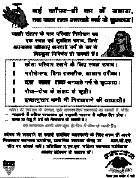 |
380A
IUCD which provides 7 to 10 years of contraception. This device
is now available at most CHCs, PHCs and sub centres.
However, awareness of its features and benefits among both
service providers and prospective clients is abysmal. In light
of this, SIFPSA has planned a campaign on IUCD promotion.
As a first step towards this, separate handbills and leaflets
have been designed both for use during provider orientation
and for distribution to clients during counselling sessions.
These are being made available to districts through SIFPSA
PMUs.
|
|
d |