| b |
Reproductive Health Within Reach
The
IFPS Project was designed before the Cairo Conference. Thus the
project objective was to expand family planning information and
services to increase contraceptive prevalence and reduce fertility.
It was only after the mid term assessment of the Project that it
was decided to include reproductive health indicators in 1998. These
relate to ante natal care and safe delivery services. After preliminary
research it was decided that the percentage of pregnant women receiving
two doses of Tetanus Toxoid (TT) would be a suitable indicator of
access to antenatal care. Similarly, deliveries attended by trained
providers could act as a surrogate for safe delivery services. Expected
levels of achievement were determined for each of these indicators
year wise by USAID. These were to be annually tracked by independent
surveys.
| |
 |
| O |
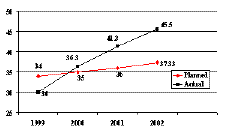
Deliveries
Attended by Trained TBAs |
Extending
Antenatal Care
SIFPSA also started a host of activities for orientation, capacity
building and service delivery related to reproductive health. Notable
among these was the tetanus toxoid campaign for pregnant women.
This innovative strategy was adopted to bring services to difficult
to reach target groups quickly, in a cost effective manner, using
a mix of private and public sector resources.
A door to door enumeration of pregnant women was carried out by
grassroots workers to register them for antenatal care. An innovative
IEC campaign involving women’s groups and community based
female volunteers with a strong interpersonal counselling element
was used. This conveyed the benefits of TT immunization both for
the mother and the new born and exhorted women to visit the immunization
centres during the campaign period.
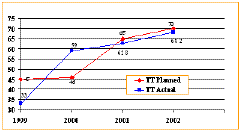
The antenatal coverage which was stagnant, rose sharply to well
above planned levels from 1999 onwards till the campaign continued
upto 2002. During this period, ambitious targets of ANC were met.
The campaign also sharply raised awareness levels about the grave
risk of tetanus to mother and new borns and that tetanus was preventable.
 |
|
Pregnant
Women Protected from Tetanus |
O |
Improving
Delivery Practices
Simultaneously SIFPSA developed its traditional birth attendant
(TBA) training strategy. What set it apart from other similar programmes,
however, was the process followed, which had a unique private-public
sector partnership component.
While the private sector (an NGO in each district) handled the training
of lead trainers, the health department actually conducted training
of the dais and maintained post-training linkages to provide services
to all pregnant women and screen referrals of high-risk cases. It
also saw the development of a training curriculum as well as materials
to support the training drawing on the best expertise available
in the government & NGO sectors.
The dais were trained for the following :
1. to conduct deliveries in aseptic conditions using “five
cleans”
2. to identify and refer high risk pregnant women
3. to promote family planning
4. to counsel on importance of antenatal care.
Since the dai is normally an illiterate village woman, record keeping
and reporting by dais was kept to a minimum and these were in pictorial
form.
Efforts were made to train at least one dai from every village.
Support of pradhans was elicited by inviting them to the valedictory
session of the training programme. Trained dais were provided identity
cards & name boards. They were followed up & supervised
by ANM. Promotion of safe motherhood & trained dais through
wall paintings & other activities was also done.
As a result of this intervention which began in 1999 and spread
to 17 districts, the safe delivery indicator shot up to well above
planned levels and is today about 8 percentage points above the
targets set by USAID.
|
d |